Giants: The Parallel Lives of Frederick Douglass and Abraham Lincoln (2008)
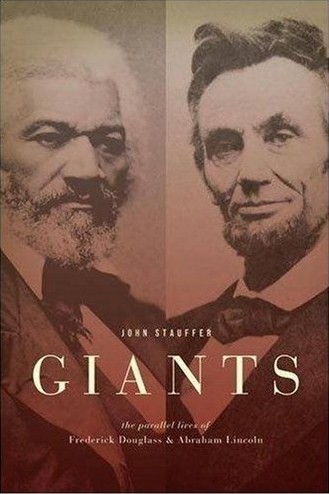
Douglass and Lincoln were the preeminent self-made men of their time. In this masterful dual biography, the first to view the two great leaders as self-made men, Stauffer describes the transformations in the lives of these giants during a major shift in cultural history, when men rejected the status quo and embraced new ideals of personal liberty.
As Douglass and Lincoln reinvented themselves and became friends, they transformed America. Lincoln was born dirt poor, had less than one year of formal schooling, and became the nation's greatest president. Douglass spent the first 20 years of his life as a slave, had no formal schooling, and became one of the nation's greatest writers and activists. At a time when most whites would not let a black man cross their threshold, Lincoln invited Douglass into the White House. Lincoln recognized that he needed Douglass to help him destroy the Confederacy and preserve the Union; Douglass realized that Lincoln's shrewd sense of public opinion would serve his own goal of freeing the slaves. Their relationship shifted in response to the debate over slavery and emancipation. Stauffer describes their personal and political struggles with a keen understanding of the dilemmas they confronted and the social context in which they occurred. What emerges is a brilliant portrait of how two of America's greatest leaders lived.
As Douglass and Lincoln reinvented themselves and became friends, they transformed America. Lincoln was born dirt poor, had less than one year of formal schooling, and became the nation's greatest president. Douglass spent the first 20 years of his life as a slave, had no formal schooling, and became one of the nation's greatest writers and activists. At a time when most whites would not let a black man cross their threshold, Lincoln invited Douglass into the White House. Lincoln recognized that he needed Douglass to help him destroy the Confederacy and preserve the Union; Douglass realized that Lincoln's shrewd sense of public opinion would serve his own goal of freeing the slaves. Their relationship shifted in response to the debate over slavery and emancipation. Stauffer describes their personal and political struggles with a keen understanding of the dilemmas they confronted and the social context in which they occurred. What emerges is a brilliant portrait of how two of America's greatest leaders lived.
|
Prologue: Meeting the President 1
1 Privileged Slave and Poor White Trash 25 2 Fugitive Orator and Frontier Politician 67 3 Radical Abolitionist and Republican 129 4 Abolitionist Warrior and War President 213 5 Friends 273 Epilogue 303 Notes 319 Index 417 |
* Annual Iowa Author Award * Boston Author's Club Book Award * Progressive Book Club featured selection * History Book Club featured selection * Boston Globe and Amazon bestseller * More than 30,000 hardcover copies sold * Translated into Mandarin, Arabic, and Korean |
An original, eloquent, unsentimental examination of both men and their legacies--Los Angeles Times
Stauffer tells the parallel stories of these two giants with grace and insight--Seattle Times
Illuminating… [Stauffer] effectively captures the predicaments of the two men... [Their story] gains fresh color in this swift-moving, stylish account
--Publishers Weekly
Outstanding... a brilliant introduction to the lives of the preeminent black and white men of their era, with a timely epigraph by Barack Obama
--Providence Journal-Bulletin
An important piece of the Lincoln bicentennial legacy… a highly narrative and satisfying work… a welcome balance to the growing legend of Lincoln standing alone in emancipating the slave--Buffalo News
In his deeply probing study, Stauffer vividly evokes a coarse, hurly-burly America where, just as today, politics was vicious--St. Petersburg Times
Subtle, keenly perceptive, and blessedly concise...the parallels he draws between Douglass and Lincoln are real and illuminating--Christianity Today
The friendship they forged, Stauffer argues, elegantly and eloquently, help us to understand a major shift in American history--Baltimore Sun
A masterful portrait of the two men who led the nation to an expansion of the definition of 'freedom for all and tyranny toward none' [...], of the social and political atmosphere of mid-19th-century America and the struggle to make the United States truly united—Roanoke Times
Giants will satisfy with the fresh light it casts upon two towering figures in American history as they played out the roles that destiny had chosen for them - neither fully right and both flawed, but hewn from the same tree of idealism, determination and love of their people--BookReporter
One of the most brilliantly conceived books of 2008... no previous biographer has intertwined their lives as skillfully.... Stauffer not only shares these men’s stories with expert grace but also demonstrates the centrality of dynamic individuals in the study of history.... It offers hope for true dialogue among those who could just as easily hate as they could reason--American Way
Wonderful narrative verve....This fascinating book will be of interest to popular audiences and academics alike--Newark Star Ledger
Giants is a perfect starting place for those whose interest in two of American history's most important figures has been piqued--Washington Post
Valuable insights... Stauffer's intelligent discussion of Ottilie Assing deserves special mention--Weekly Standard
Giants is a lyrical, insightful treatment of the fascinating relationship between two geniuses, one a politician and the other a radical reformer. Both Lincoln and Douglass heard the music of words in their heads as few others, and Stauffer has an ear for the two of them in harmony. That they started in such different places ideologically and yet moved together at the critical moment of emancipation makes this a timely and important book. Stauffer brings the tools of literature and history to bear on this comparison with unmatched skill--David Blight
Stauffer's collective biography stands apart by focusing on how each man continually remade himself. In the process he gives us the texture and feel of the strange worlds that they inhabited. The result is a path-breaking work that dissolves traditional conceptions of these two seminal figures. He reveals how Douglass towered over Lincoln as a brilliant orator, writer, agitator, and public figure for most of his life. He shows us how words became potent weapons for both men. And he tells the poignant story of how these preeminent self-made men converged and helped transform the nation--Henry Louis Gates, Jr.
In this stunning book, Stauffer has given us the most insightful portrait of either Lincoln or Douglass in years. In graceful prose, he tells a moving story of the two men who dominated 19th-century American life, as allies across the racial divide, friends who drew common inspiration from hard scrabble beginnings and a love of language, and fellow travelers on the road of American self-making. Giants is simply must reading!--Richard S. Newman
Like a daguerreotype, which 19th-century Americans thought captured not simply surface appearances but peoples' souls, this book moves beyond biography to allow us to recover the inner lives of two utterly uncommon common men. This is the most insightful book about race and friendship in the 19th century that I have read. It's poignant and perceptive, a book to be savored, a book that will last--Steven Mintz
